Home > Home > About > Who Created the Pacta Petfood-Score Concept?
Pet food transparency
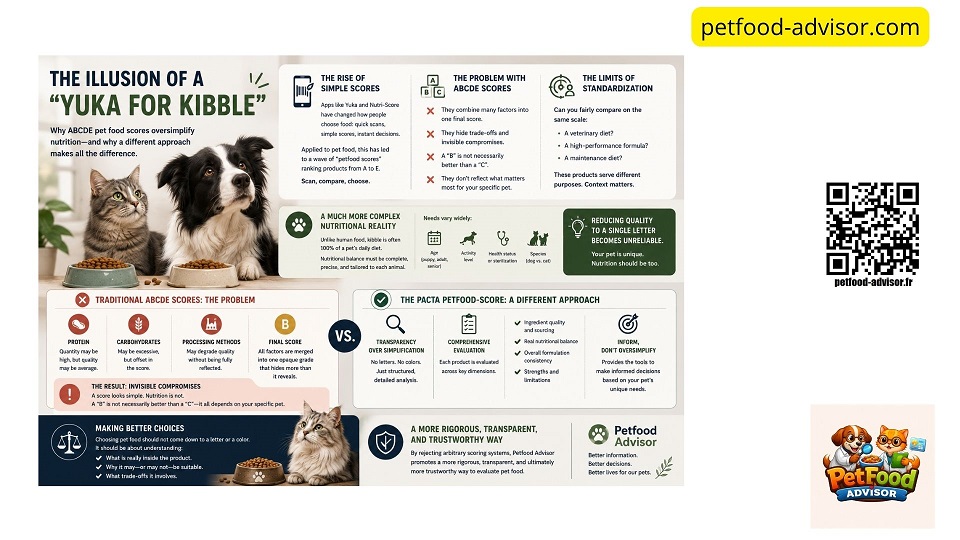 Who Created the Pacta Petfood-Score Concept?
Why the “Pacta Petfood-Score” rejects A-to-E ratings
Thursday 21 May 2026, by
The “Pacta Petfood-Score,” created by Alain Stevens from Petfood Advisor, was born from a simple observation: A-to-E rating systems applied to pet food are appealing—but fundamentally misleading. At a time when consumers seek quick reassurance, this initiative offers a more demanding, but far more reliable alternative.
The illusion of a “Yuka for kibble”
The success of apps like Yuka and systems like Nutri-Score has changed how people choose food: quick scans, simple scores, instant decisions.
Applied to pet food, this idea has led to a wave of “petfood scores” ranking products from A to E. On the surface, it sounds ideal: scan, compare, choose.
But this promise relies on oversimplification—and that’s where it breaks down.
A much more complex nutritional reality
Unlike human food, kibble is not eaten occasionally. For many pets, it represents 100% of their daily diet.
That creates a much higher level of responsibility: the nutritional balance must be complete, precise, and tailored to each animal.
And those needs vary widely:
Age (puppy, adult, senior).
Activity level.
Health status or sterilization.
Species (dog vs. cat).
In this context, reducing quality to a single letter becomes unreliable.
The problem with ABCDE scores
A-to-E rating systems work by combining multiple criteria into one final score.
But with pet food, this creates what can be called “invisible compromises.”
For example:
Protein quantity may be high, but quality may be average.
Carbohydrates may be excessive but offset in the score.
Processing methods may degrade quality without being fully reflected.
By merging all these factors into one opaque grade, the final score hides more than it reveals.
A “B” is not necessarily better than a “C”—it all depends on your specific pet.
The limits of standardization
Another key issue is the idea of a universal scoring system.
Can you fairly compare on the same scale:
A veterinary diet designed for a medical condition?
A high-performance formula for active dogs?
A maintenance diet for sedentary pets?
These products serve entirely different purposes. Reducing them to a single scale strips away essential context.
The Pacta Petfood-Score: a different approach
This is where Alain Stevens and Petfood Advisor take a clear stand.
The Pacta Petfood-Score is not another rating system—it is a response to the flaws of existing ones.
Its core principle is simple: refuse to reduce complexity to a single grade.
Transparency over simplification
Instead of assigning A, B, or C scores, Petfood Advisor focuses on structured, detailed analysis.
Each product is evaluated across key dimensions:
Ingredient quality and sourcing.
Real nutritional balance.
Overall formulation consistency.
Strengths and limitations.
This approach gives pet owners a clearer, more honest understanding of what they are feeding.
Inform, don’t oversimplify
Simple scores feel reassuring—but in pet nutrition, they can be misleading.
The Pacta approach prioritizes education over instant judgment. Rather than delivering a quick verdict, it provides the tools to make informed decisions based on each pet’s needs.
Making better choices
Choosing pet food should not come down to a letter or a color.
It should be about understanding:
What is really inside the product.
Why it may—or may not—be suitable.
What trade-offs it involves.
By rejecting arbitrary scoring systems, Petfood Advisor promotes a more rigorous, transparent, and ultimately more trustworthy way to evaluate pet food.