Home > Home > About > Who really created the first ABCDE petfood-score?
Pet food misinformation and viral scoring systems
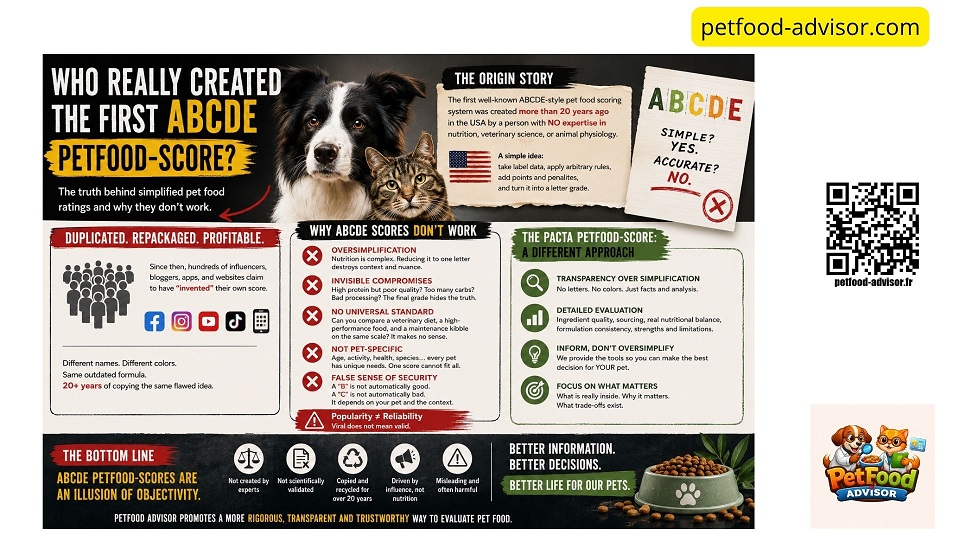 Who really created the first ABCDE petfood-score?
The hidden history behind simplified pet food ranking systems and why they continue to spread across social media today
Thursday 21 May 2026, by
Today, hundreds of influencers, websites, Facebook groups, mobile applications, and social media accounts claim to have invented revolutionary “petfood-score” systems using simplified A-B-C-D-E rankings. Most present these methods as scientific, objective, and indispensable for choosing kibble or wet food. However, very few consumers know the real origins of these scoring systems. The first widely known ABCDE-style pet food ranking methods appeared more than twenty years ago in the United States and were not created by veterinary nutrition specialists or scientific institutions. Since then, the concept has been endlessly duplicated, modified, repackaged, and recycled online — despite its major nutritional limitations.
The origin of simplified pet food scores
Long before TikTok influencers, Instagram “pet nutrition experts,” or viral comparison apps existed, simplified pet food scoring systems had already started circulating online in the United States.
The first well-known ABCDE-style pet food rankings emerged more than twenty years ago on early internet forums, blogs, discussion groups, and independent websites dedicated to dog and cat nutrition.
Contrary to what many people imagine today, these systems were not initially developed by recognized veterinary nutrition researchers, scientific institutions, or specialists in animal physiology.
In reality, some of the earliest popular pet food scoring methods were created by individuals with no formal expertise in veterinary nutrition or advanced nutritional science.
The idea was simple:
take publicly available information from pet food labels, combine a series of arbitrary criteria, apply bonuses and penalties, and transform the result into an easy-to-read score.
At first glance, the concept looked attractive because it gave consumers the illusion of simplicity in a very complex market.
Unfortunately, simplicity is precisely where the problem begins.
The illusion of scientific objectivity
One of the reasons these systems became so successful is psychological.
Consumers naturally prefer:
quick answers,
easy comparisons,
visual rankings,
simple colors,
and immediate conclusions.
An A-B-C-D-E classification appears reassuring because it creates the impression that nutrition can be summarized instantly through a universal score.
Many users therefore assume:
an “A” automatically means healthy,
a “C” means average,
and an “E” means dangerous.
But pet nutrition does not function like a school exam.
A dog or cat is not a smartphone, a washing machine, or a restaurant review.
Nutrition involves:
physiology,
metabolism,
digestibility,
ingredient sourcing,
processing methods,
bioavailability,
feeding context,
age,
activity,
sterilization,
medical conditions,
and many other variables.
Reducing all these elements into one simplistic final grade inevitably destroys context.
Duplicated endlessly across the internet
Over the years, these early American scoring systems inspired countless copies.
Today, hundreds of influencers, bloggers, YouTubers, Facebook groups, mobile applications, and websites claim to have created their own “revolutionary” petfood-score.
In reality, most of these systems simply recycle the same basic idea:
assign points,
apply penalties,
combine unrelated criteria,
and produce a final letter or number.
Some modify the formulas slightly.
Others change the colors or visual presentation.
Some pretend to use artificial intelligence.
Others market their rankings as “scientific” or “independent.”
But the underlying logic remains almost identical.
The same simplistic approach has therefore been duplicated and repackaged for more than two decades.
In many cases, influencers present these systems as original inventions even though very similar scoring models have circulated online since the early days of internet pet communities.
Why these systems are unreliable
The main problem is not simply who created these scores.
The deeper issue is that the concept itself is fundamentally flawed.
A pet food score built from simplified formulas cannot realistically evaluate:
true ingredient quality,
digestibility,
nutrient bioavailability,
manufacturing quality,
contamination risks,
sourcing consistency,
physiological adaptation,
or the individual needs of each animal.
Two foods with similar analytical values may behave completely differently in practice depending on:
ingredient origin,
industrial processing,
cooking temperature,
storage conditions,
or protein digestibility.
At the same time, a veterinary diet designed for a specific medical condition may intentionally prioritize completely different nutritional objectives than a high-performance formula for sporting dogs.
Comparing them through one universal A-B-C-D-E scale becomes meaningless.
The danger of “invisible compromises”
One of the biggest problems with petfood-scores is what could be called invisible compromise.
A final score may hide major nutritional trade-offs.
For example:
a food may contain high protein levels but average ingredient quality,
carbohydrates may be excessive but compensated elsewhere in the formula,
processing methods may reduce nutritional quality,
mineral balance may remain questionable,
or digestibility may not be properly reflected.
When all these factors are merged into one opaque final score, the consumer no longer sees the complexity behind the product.
The score creates the illusion of clarity while actually hiding uncertainty.
This is why an apparent “B” product is not necessarily better than a “C” product.
Everything depends on:
the animal,
the feeding context,
the physiological objective,
and the interpretation of the data.
The social media amplification effect
Modern social media platforms accelerated the popularity of these systems dramatically.
Algorithms favor:
emotional reactions,
controversy,
simplified messages,
viral rankings,
and fear-based content.
A colorful “Top 10 best kibbles” video generates far more engagement than a detailed discussion about digestibility, bioavailability, or nutritional context.
As a result, many influencers adopted simplified petfood-score systems because they are:
visually effective,
easy to explain,
highly shareable,
and commercially attractive.
Unfortunately, popularity does not equal scientific reliability.
Many consumers now confuse:
viral visibility,
follower counts,
and confident presentation
with actual nutritional competence.
Why Petfood Advisor rejects the ABCDE philosophy
This is precisely why Petfood Advisor takes a different position.
The project rejects the idea that pet nutrition can be summarized honestly through arbitrary universal grades.
Instead of assigning simplistic A-B-C-D-E scores, Petfood Advisor focuses on:
contextual analysis,
measurable data,
evolving databases,
comparison tools,
nutritional interpretation,
and critical thinking.
The goal is not to tell consumers:
“This food is good.”
“This food is bad.”
The objective is to help users understand:
what is inside the product,
how the formulation works,
what strengths and limitations exist,
and whether the recipe fits their own animal’s needs.
This approach may appear less spectacular than viral ranking systems.
However, it is also far more transparent and intellectually honest.
A more responsible vision of pet nutrition
Pet nutrition deserves better than simplified internet grades invented decades ago and endlessly duplicated by influencers searching for engagement.
Choosing food for a dog or cat should never depend entirely on:
a color,
a letter,
or a viral ranking.
Real nutritional understanding requires nuance, context, transparency, and continuous learning.
The popularity of ABCDE petfood-scores does not make them reliable.
In many situations, these systems create more confusion than clarity.
Petfood Advisor promotes a different vision:
less simplification,
more explanation,
less emotional marketing,
more structured analysis,
and better tools for informed decision-making.
Because in nutrition, reality is always more complex than a single score.