Home > Home > About > Why Petfood Advisor was created
Understanding modern pet nutrition
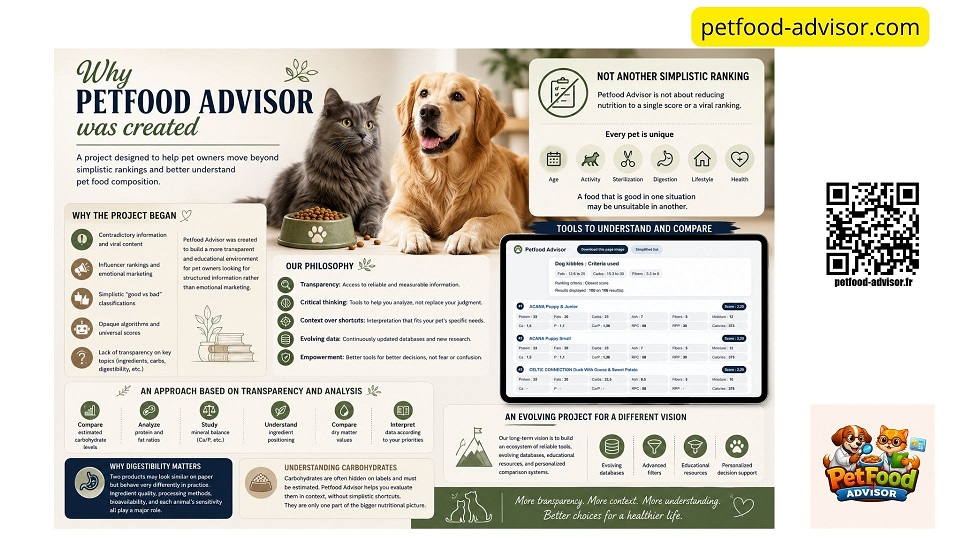 Why Petfood Advisor was created
A project designed to help pet owners move beyond simplistic rankings and better understand pet food composition
Thursday 21 May 2026, by
The pet food market has become increasingly complex for consumers. Between viral social media content, contradictory influencer advice, emotional marketing campaigns, and simplified “good versus bad” scoring systems, many pet owners struggle to understand what they are truly feeding their dogs and cats. Petfood Advisor was created to offer a different approach: one centered on transparency, contextualized information, evolving databases, and informed decision-making rather than simplistic universal rankings.
Why the project began
Petfood Advisor was born from a simple observation: pet owners are exposed to a massive amount of contradictory information about nutrition.
On one side, some websites or influencers claim that certain products are “perfect.” On the other side, other creators describe the exact same foods as “dangerous” or “toxic.” Social media algorithms often amplify emotional content, dramatic warnings, and simplified nutritional claims because those formats generate engagement and reactions.
At the same time, many consumers genuinely want to understand pet food composition more seriously. Unfortunately, they quickly discover that nutrition is far more complex than viral rankings suggest.
Petfood Advisor was therefore created to build a more transparent and educational environment for pet owners looking for structured information rather than emotional marketing.
Moving beyond simplistic scoring systems
One of the core ideas behind the project is that pet nutrition cannot realistically be reduced to a universal A-B-C-D-E score.
Many modern applications attempt to summarize complex nutritional data into a single letter grade or a simplified score. While these systems may appear reassuring at first, they often hide important limitations:
nutritional needs vary from one animal to another,
ingredient quality cannot always be measured through labels alone,
manufacturing processes matter,
digestibility remains difficult to evaluate,
and analytical values must always be interpreted in context.
A highly active working dog, an indoor sterilized cat, a growing puppy, or a senior animal do not have identical nutritional requirements.
A food that may appear interesting for one pet could become completely unsuitable for another.
Petfood Advisor was designed around the idea that consumers need tools to think critically, not algorithms that replace their judgment entirely.
An approach based on transparency and analysis
Rather than focusing on emotional “best food” rankings, Petfood Advisor aims to provide measurable and contextualized information.
The project progressively develops:
evolving nutritional databases,
comparison tables,
customizable filters,
ingredient analysis tools,
carbohydrate estimation systems,
dry matter calculations,
contextual nutritional interpretation,
and educational resources for consumers.
The objective is not simply to label foods as “good” or “bad,” but to help users better understand the strengths and limitations of recipes.
For example, Petfood Advisor tools may help users:
compare estimated carbohydrate levels,
analyze protein and fat ratios,
study calcium/phosphorus balance,
understand ingredient positioning,
compare dry matter values,
and explore nutritional data according to their own priorities.
Understanding carbohydrates and hidden nutritional data
One of the major discussions in modern pet nutrition concerns carbohydrates.
In many countries, manufacturers are not required to directly display carbohydrate percentages on packaging. Consumers usually only see:
proteins,
fats,
fibers,
ash,
and moisture.
As a result, carbohydrate levels are often estimated through calculations.
Petfood Advisor helps users understand these estimations in a more contextualized way. The project does not promote simplistic shortcuts such as:
“low carb automatically means healthy”
or
“high carb automatically means dangerous.”
Instead, carbohydrate analysis is presented as one part of a broader nutritional evaluation that must also consider:
protein quality,
digestibility,
ingredient sourcing,
fiber balance,
manufacturing methods,
and the overall physiological needs of the animal.
Why digestibility matters
Digestibility is another important topic frequently misunderstood online.
Two products may display very similar analytical values on paper while producing very different results in practice depending on:
ingredient quality,
bioavailability,
protein sourcing,
processing methods,
and the animal’s own digestive sensitivity.
Petfood Advisor recognizes that digestibility cannot realistically be summarized through a simplistic public score or determined by scanning a label alone.
The project instead encourages consumers to combine multiple sources of information:
ingredient analysis,
nutritional context,
stool quality observations,
feeding adaptation,
and comparative data.
A customizable philosophy
Another important goal behind Petfood Advisor is personalization.
Unlike rigid universal scoring systems, the project aims to progressively allow users to adapt their own evaluation criteria according to their pets’ specific needs.
For example, users may eventually prioritize:
lower estimated carbohydrates,
higher protein levels,
digestive sensitivity,
indoor lifestyles,
senior nutrition,
mineral balance,
ingredient preferences,
or other contextual factors.
This philosophy reflects a central idea:
there is no single “perfect” food for every animal.
Nutrition must always be interpreted according to context, physiology, lifestyle, and individual needs.
An evolving project
Petfood Advisor remains an evolving platform.
New databases, tools, comparison systems, educational resources, and search features are continuously being developed and improved.
The ambition is not to create another viral ranking website, but to progressively build:
a transparent nutritional ecosystem,
a reliable comparison platform,
and an educational resource helping consumers better understand the reality of modern pet nutrition.
The project also aims to encourage more critical thinking around pet food marketing, influencer culture, and simplified nutritional narratives that dominate many online discussions today.
A different vision of pet nutrition
Ultimately, Petfood Advisor was created because many pet owners deserve better tools than fear-based marketing, opaque algorithms, and emotional social media debates when making decisions about their animals’ nutrition.
The project promotes a different vision:
more transparency,
more context,
more measurable information,
and more informed decision-making.
Because nutrition is complex.
And because responsible choices deserve better than simplistic rankings.